Behind the data: using Copernicus Sentinel-3 observations to monitor sargassum seaweed
Satellite instruments can be used to detect and track sargassum seaweed

The record-breaking amount of sargassum seaweed that accumulated in and around the Caribbean in 2025 can be seen using Copernicus Sentinel-3 satellite observations. EUMETSAT’s Dr Hayley Evers-King describes how these data make it possible to track the phenomenon, benefitting coastal communities.
The United Nations has designated the period 2021–2030 as the Decade of Ocean Science for Sustainable Development and issued ten challenges with the goal of achieving a clean, safe, and accessible ocean by 2030. To support this goal, EUMETSAT is developing case studies that address each of the United Nations' challenges. This article is the tenth in a series in which one case study author gives us the story behind the data, illuminating how satellite data from EUMETSAT and the European Union's Copernicus programme contribute to a better future for us and our ocean.
Key points
- In 2025, a record-breaking more than 37.5 million metric tons of sargassum seaweed grew in the Gulf of Mexico, Caribbean seas, and parts of the Atlantic Ocean.
- The Ocean and Land Colour Instrument on board Copernicus Sentinel-3 satellites provides valuable observations for detecting the seaweed, which threatens the health of coastal communities when it washes on shore.
- The enormous influx of sargassum seaweed last year is part of a years-long trend that may be linked to human-caused ocean warming.
Sargassum through a sharper set of eyes
“In these images, we can see sargassum in the southern Caribbean on 14 May 2025. In the image on the left, which has a kind of classic blue colour you would expect when looking at the ocean, the satellite measurements have been shown similarly to how they would look if the light was received by a human eye.”
Sargassum in the southern Caribbean
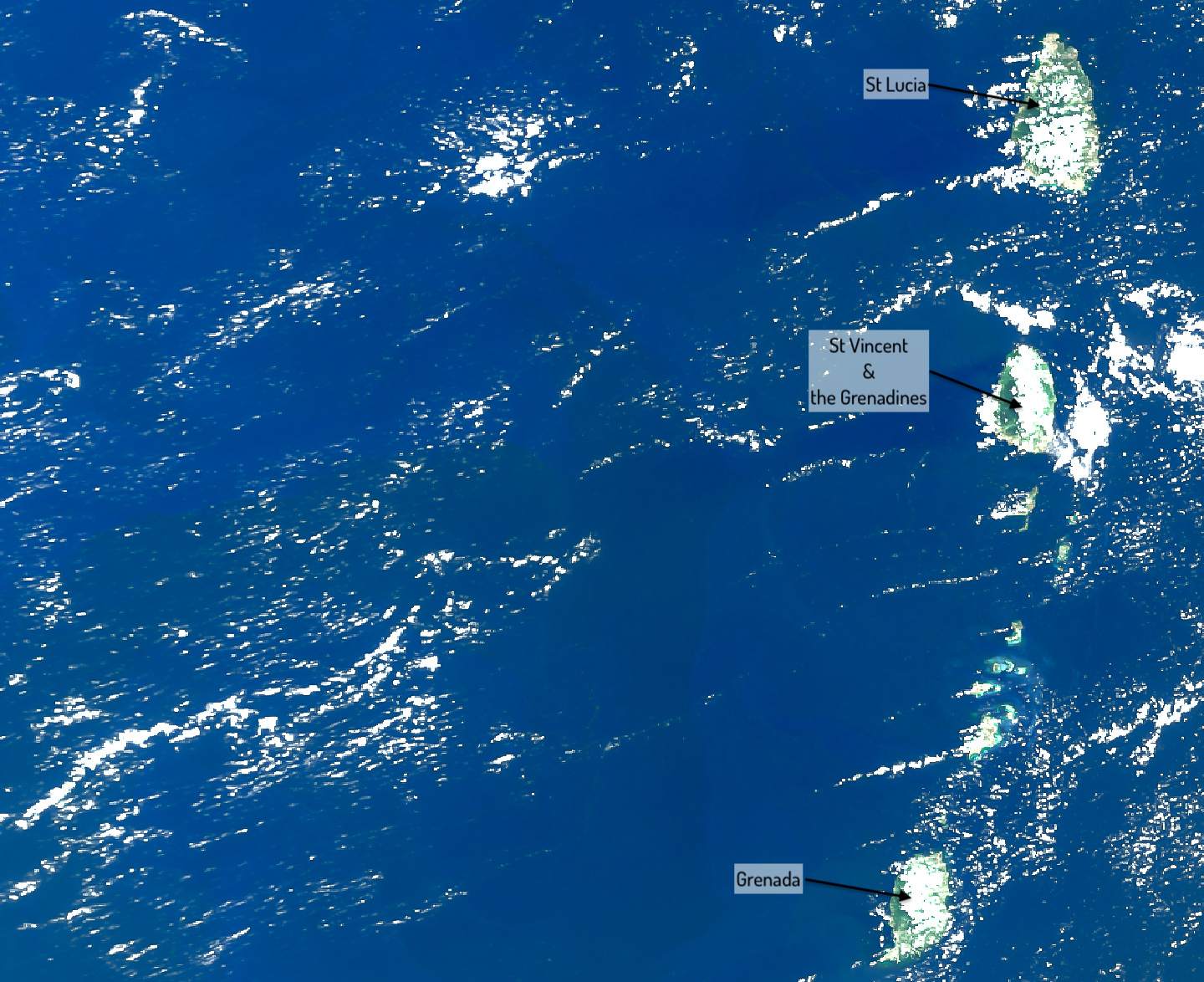
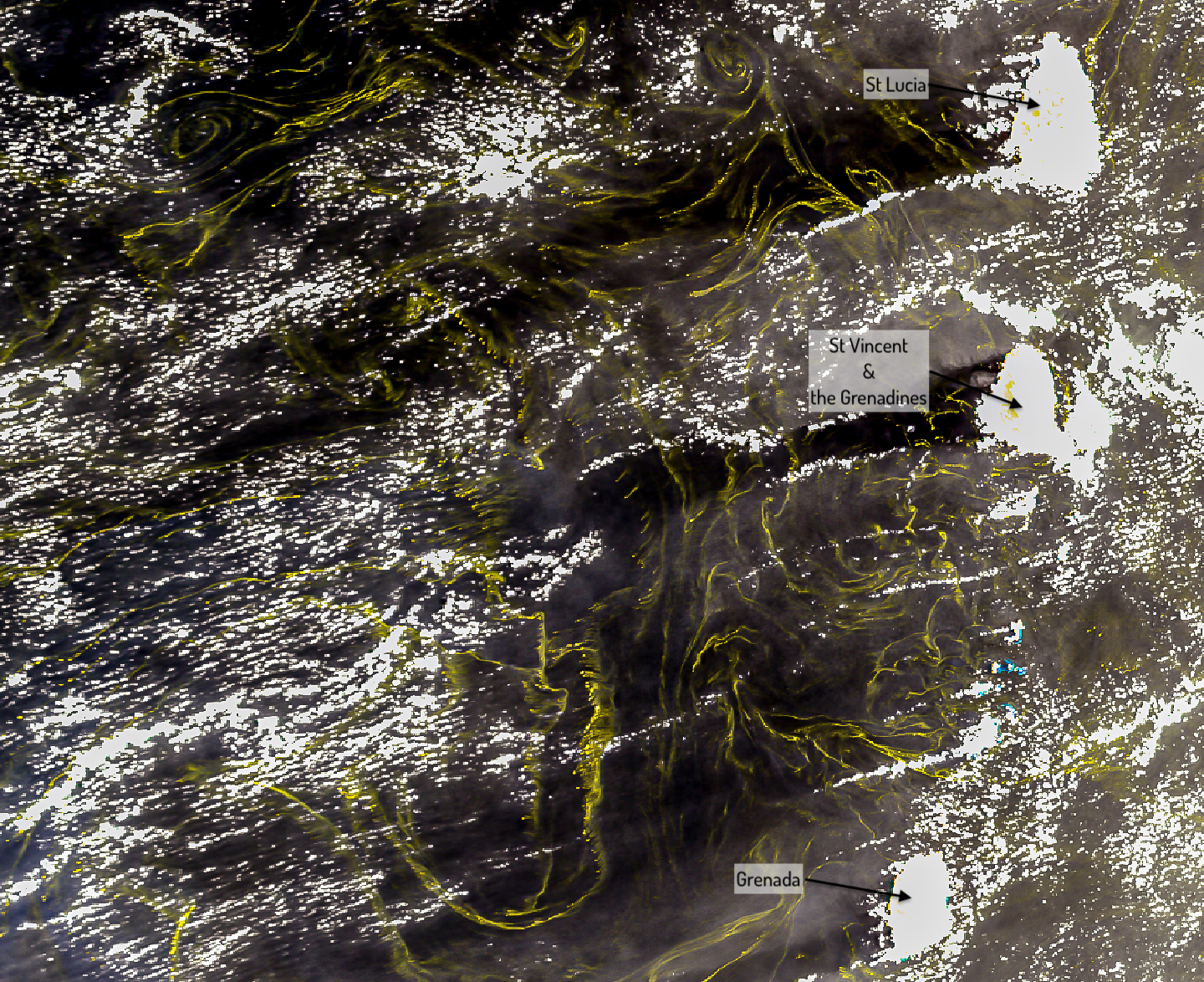
The Ocean and Land Colour Instrument on board Copernicus Sentinel-3 satellites shows the extent of sargassum in the southern Caribbean on 14 May 2025. On the left, the ocean as though seen by the human eye is shown. On the right, the effects of the atmosphere have been removed, highlighting the yellow-green sargassum.
“With the Ocean and Land Colour Instrument, we have a much sharper set of eyes to look at the different colours beyond what the human eye can capture. In the image on the right, we have removed the effect of the atmosphere, so the image looks much less blue. This highlights the green-brown parts of the spectrum, which makes it easier to see the features of the sargassum there.
“Basically the green swirls are sargassum, and where it is more yellow-green there is either a higher concentration of it, it is closer to the surface, or both. The white patches are either islands or clouds. This spring bloom was one of the largest accumulations of sargassum in all of 2025. There has been a regime shift in recent years where there has been a lot more sargassum in general.
“And the last few years have been particularly bad. Experts are still trying to figure out exactly what it is that has been driving this. It could be warmer water and more nutrient input, which are related factors. There is probably a link to larger scale climate phenomena that may explain why more sargassum has been growing and washing ashore in the Caribbean.”
Crucial for coastal management
“What you see here is the biomass density of sargassum, which is the amount of sargassum per unit area, in that same stretch of the Caribbean. The more yellow-green the colour, the more sargassum there is. The pure green splotches running down the right side of the image are Caribbean islands and the white patches are clouds.”
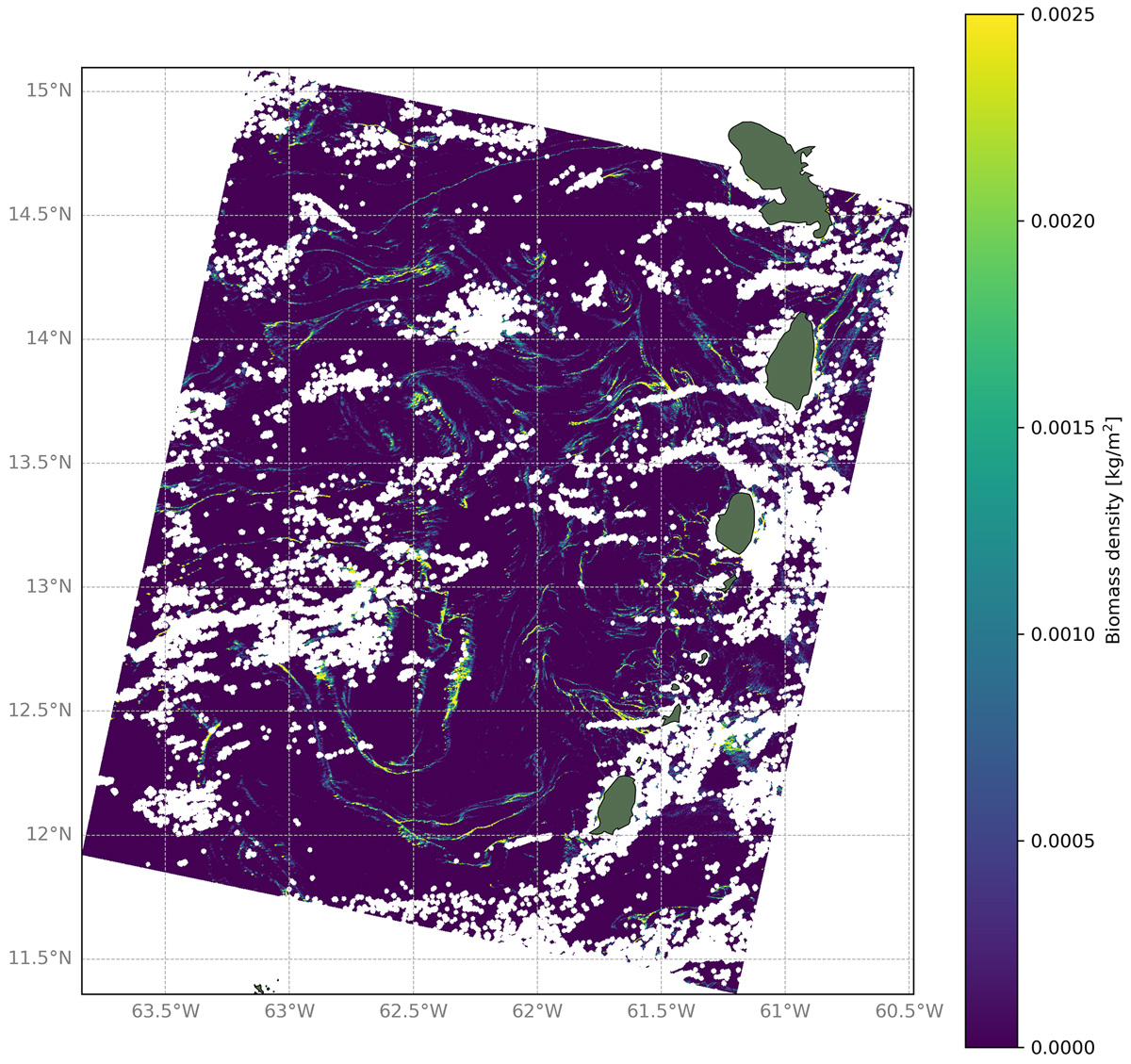
“When we create images like this one, we take the quantities of reflected light the Ocean and Land Colour Instrument detects and relate that to the amount of sargassum that is there. For example, the bright yellow-green patch around 12.5 degrees North and 62.5 degrees West shows a high concentration of biomass.
“This mixture of light measured includes some in the visible spectrum, which we can see, as well as some in the near-infrared spectrum, which our eyes cannot see. The satellite also shows how the amount of reflected light varies in detail across that spectrum. So, we are actually able to get more information from the satellite instrument than we would be able to with our eyes alone.
“We can use this information to tell us about ocean life, for example, how green the ocean is corresponds with the amount of algae present. It is also worth noting that plant material like sargassum that floats on the surface of the ocean tends to have a particular signal in the part of the spectrum this satellite instrument detects, which helps us to identify it. It is particularly bright and reflects light in certain parts of the spectrum more than other things do.
“This image differs from the side-by-side images above because while those were qualitative, this one is quantitative and so provides a much more robust, detailed estimate of how much sargassum there is. This is super useful because you cannot feed a colour into a model, but you can feed a number into it. For example, if you want to use a model to predict where a patch of sargassum is going to go, you can feed its biomass into the model, which can then work out all the maths associated with the currents. This can tell you where the sargassum might go. You could also use this to quantify the influx of nutrients sargassum is pulling into the ocean, or compare the amount of sargassum in 2025 to a previous year.
“Given that when sargassum washes on shore and rots, it emits toxic gases such as hydrogen sulfide and ammonia quantifying it can be really helpful in enabling coastal communities to mitigate the risks better. Schools may choose to shut down to protect kids from the poor air quality. Sargassum can also carry bacteria like Vibrio cholerae, which causes cholera and can bioaccumulate heavy metals that can leach into the environment. It basically turns idyllic Caribbean beaches into stinky compost heaps.
“Satellite instruments are really the only method we have to detect sargassum in large areas of the open ocean as it moves towards coastal environments, so the data they provide are very important for coastal management. Communities can then organise beach clean-ups to remove the seaweed, and some places are even working on transforming it into biofuel. This is a really nice example of satellites having a practical application that benefits communities concretely.”
Interested in diving deeper?
Check out the case study and the accompanying Jupyter Notebook.
Author:
Sarah Puschmann